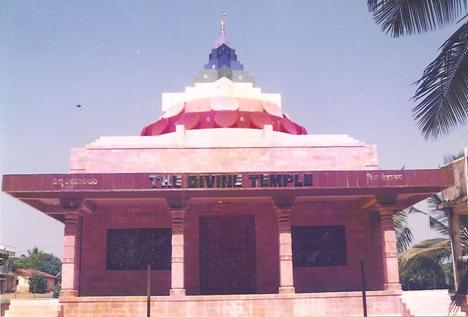
Divya Devalaya. (The Divine Temple) at Tapovan, Dharwad, Karnataka, India
Construction of the building for such Adepts is a very demanding job. They had given specific directions to Shri Swamiji to use his own personal money for this job and no donations were allowed to be taken from the public, because it was not known how the money given by the public had been obtained. With all probability, it could have been obtained through malpractice and as such should not come in use for the construction of this building. So Shri Swamiji took utmost care and did not take any donations from the public. He used his own money earned through agriculture income from his own land.
The Adepts had also given conditions to maintain the purity of the building during the course of time, namely, that only persons attaining the age of 18 should be allowed to enter the building after taking fresh bath and wearing newly washed white clothes and that they should remain inside the building for not more than 15 minutes, keeping utmost silence. In this building Shri Swamiji was to put all his powers attained through Yoga Siddhi and Mantra Siddhi throughout his life in this Janma and then they (the Adepts) would see that the Mantra Shakti is enhanced day by day.
Accordingly Shri Swamiji accepted all their conditions. He built the building as directed by them and also he put all his Mantra Shakti attained by him throughout his lifetime and immediately on completion of his work he left his physical body and became one with God Almighty, ultimately leaving the responsibility of maintaining the purity of the building on all of us.
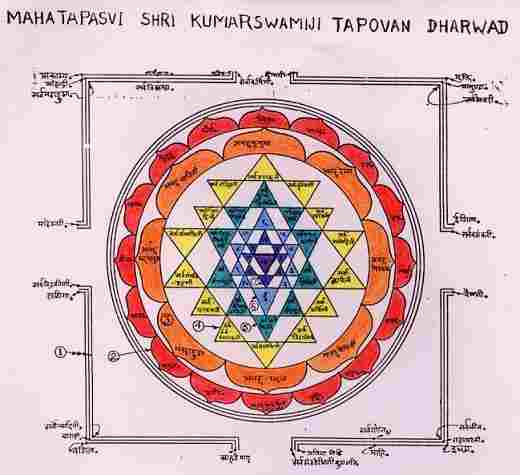
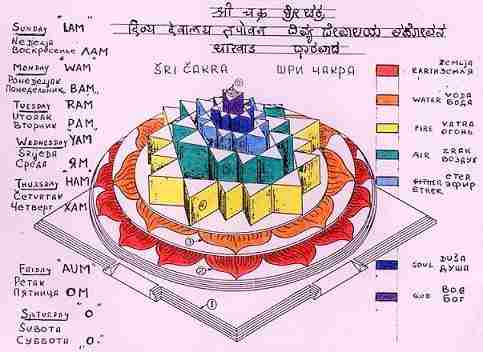
The speciality of the Divine Temple is its roof, standing on the Shri Chakra which is the king of all Chakras. Shri Chakra consists of five main triangles pointing upwards, which are of Shakti and four main triangles pointing downwards, which are of Shiva. In short it indicates the combination of Shiva with Shakti.
Shri Chakra is inclusive of the seven chakras in the astral body of a person
–
1) Muladhara, 2)
Swadhisthana, 3) Manipuraka, 4) Anahata, 5) Vishuddhi, 6) Ajna and 7) Sahasrara.
1) Muladhara Chakra has four petals and is situated above the anus. It corresponds to the gonads.
2) Swadhisthana Chakra has six petals and is situated in the region of genitals. It corresponds to the adrenals.
3) Manipuraka Chakra has ten petals and is in the region of the navel. It corresponds to the pancreas.
4) Anahata Chakra has twelve petals and is in the region of the heart. It corresponds to the thymus gland.
5) Vishuddhi Chakra has sixteen petals and is situated in the region of the throat. It corresponds to the thyroid gland.
6) Ajna Chakra has ninety six petals and is situated between the eyebrows. It corresponds to the pituitary gland.
7) Sahasrara Chakra has 972 petals which is nearly 1000, that is why it is generally called the 1000 petalled Lotus. This Chakra corresponds to the pineal gland.
These Chakras are depicted in Shri Chakra with different colours.
1) Muladhara is of red colour and its Adhidevata (the presiding deity) is Surya (Sun)
2) Swadhisthana is of orange colour and its Adhidevata is Chandra (Moon)
3) Manipuraka is of yellow colour and its Adhidevata is Mangala (Mars)
4) Anahata is of green colour and its Adhidevata is Budha (Mercury)
5) Vishuddhi is of blue colour and its Adhidevata is Guru (Jupiter)
6) Ajna is of indigo colour and its Adhidevata is Shukra (Venus)
7) Sahasrara is of violet colour and its Adhidevata is Shani (Saturn)
Thus the seven Chakras are of the seven colours of the spectrum of the sun-rays.
The basic principle in Kundalini-yoga is that the energies should involute back to the principle source. The grosser elements of the subtle body should dissolve in the subtle elements of the next class. The earth (Prithvi-Muladhara Chakra) becomes subtle and dissolves into water (Aap-Swadhisthana Chakra); water is dissolved into fire (Tejas-Manipuraka Chakra); fire similarly merges into air (Vayu-Anahata Chakra); air is absorbed into ether (Akash-Vishuddhi Chakra) and ether is resolved into Atma Tattva (Ajna Chakra) and Atma Tattva is merged into Paramatattva (Sahasrara Chakra).
The Beeja Mantra (seed Mantra) of Muladhara Chakra is LAM. If this Mantra is meditated upon in the morning, remembering the Sun (or Surya, being the Adhidevata of this Chakra), slowly slowly Muladhara Chakra of the astral body will be opened and the Kundalini Shakti will start moving upwards cossing one by one the other Chakras.
The Beeja Mantra of Swadhisthana Chakra is VAM. If this Mantra is meditated upon in the morning remembering the Moon (or Chandra, being the Adhidevata of this Chakra) the Kundalini Shakti coming from Muladhara will move up through Swadhisthana Chakra.
The Beeja Mantra of Manipuraka Chakra is RAM. If this Mantra is meditated upon in the morning remembering the Mars (or Mangal, being the Adhidevata of this Chakra) the Kundalini Shakti rising from below will pass through the Manipuraka Chakra and travel forward towards the heart Chakra.
The Beeja Mantra of Anahata Chakra is YAM. If this Mantra is meditated upon in the morning remembering Budha (or Mercury, being the Adhidevata of this Chakra) the Kundalini Shakti coming from below will pass through Anahata Chakra (heart Chakra) and travel further towards Vishuddhi Chakra.
The Beeja Mantra of Vishuddhi Chakra is HAM. If this Mantra is meditated upon in the morning rememberig Guru (or Jupiter, being the Adhidevata of this Chakra) the kundalini rising from below will pass through Vishuddhi Chakra and travel further towards Ajna Chakra.
The Beeja Mantra of Ajna Chakra is AUM. If this Mantra is meditated upon in the morning remembering Shukra (or Venus, being the Adhidevata of this Chakra) the Kundalini Shakti travelling from below will pass through Ajna Chakra and proceed further towards Sahasrara Chakra.
The Beeja Mantra of Sahasrara Chakra is «O» (Shunya or zero) which is nothing but silence, deep silence. You have to sit quietly, remembering Shani (or Saturn, being the Adhidevata of this Chakra) without chanting any mantra and setting aside all thoughts and enjoying silence and the bliss of sielnce. Now the Kundalini Shakti enters the Sahasrara Dal Chakra. Here Shakti joins Shiva and a delightful light is seen. And this is the highest achievement in one’s life – the delightful light! The Darshan of Mother Tripurasundari. This is the inner meditation on the pure Chit-Swarupa, the Supreme Being and the ultimate liberation.
Blessed are the few – few rare souls – who through the worship of the Devi Tripurasundari, lead the pure life, during their last incarnate existance in this mundane world. They are really blessed because they have discharged the duties incumbent upon human beings, preparatory to their being merged in the transcendent Existence, Consciousness and Bliss.
Shri Swamiji has very beautifully depicted the principle of Kundalini-yoga in the roof of the Divine Temple.
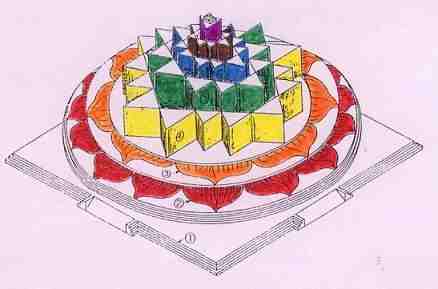
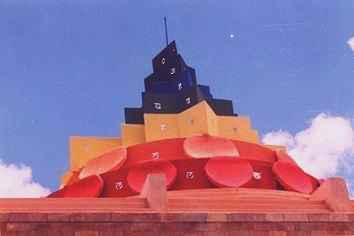
‘The Divine Temple’ in Tapovan, Dharwad built by His Holiness Shri Swamiji is based upon ‘Shri Chakra’ principles of Shakti
When we enter into the Divine Temple with the purity of the body and of the mind, having written with concentrated mind the Mahamantra // He Prabho Praseed Aum // one thousand and eight times, we observe in deep silence the band of the seven colours of the spectrum on the front wall. On this spectrum the Prithvi Tattva (earth Tattva) i.e., the red colour, starts from the top and other colours descend downwards. On the human body the Prithvi Tattva (red colour) starts from the bottom and other colours ascend upwards.
There are Siddha Mantras inscribed in golden letters one on each of the seven colours, i.e., on Prithvi Tattva, Aap Tattva, Tejas Tattva, Vayu Tattva, Akash Tattva, Atma (soul) Tattva and Paramatma (Supreme Soul) Tattva. Throughout the 87 years of his life Shri Swamiji meditated on these Mantras several thousand times and he had attained Siddhi of these Mantras. He has physically placed all his powers in these golden letters and left his mortal body immediately turning these golden alphabets into powerful Mantras. You can feel Shri Swamiji’s physical presence there in the form of these Mantras. You have to maintain deep silence and sit inside the Divine Temple for 15 minutes, read the Mantras and close your eyes. In front of your inner self you feel Shri Swamiji, you see his graceful smile, you hear his melodious voice and along with him, the Adept of 20th century – Paramhansa Vishuddhanandji Gandhababa – is alread there in his etheric body also. You can experience the gandha (fragrance) oozing perpetually out of his body.
This is how Shri Swamiji is with us and he will always be with us, till the Sun and the Moon are visible from this Earth. Shri Swamiji himself has said that in the near future he will again be coming back on this Earth, with a new body in a new form and continue his work of bestowing global peace and universal love and this time he is going to physically spread universal love in the minds of one and all on this globe.
We are proud of our Swamiji !
OM SHANTI | OM SHANTI | OM SHANTIHI
Shri Sadashiv Golsangi